Friday, 25 July 2014

Canada Goose Chase, Bryn Bach Park, South Wales


Such a beautiful setting for this annual event.
Its not often we get to witness the annual Canada Goose Chase. Crowds gather on the pathway surrounding the lake, some with children in pushchairs, youngsters on scooters, couples holding hands, all waiting.

Always held at the height of summer, although not always well advertised beforehand, the geese congregate to compete to be the first past the finishing post...

Waiting to register and receive their entry number.

The Starter sits patiently in position, waiting for the competitors.
Jostling for position they disappear along the lake.


THEY'RE  OFF !
Exhausted but excited they scramble up the slipway to reach the Finish.


The Winner takes a bow.


Friday, 18 July 2014

Sir Tony Robinson & South Wales Canals


Waterlilies on the Pontnewynydd section
The Monmouthshire and Brecon Canal, originally built to carry coal and iron to Newport is currently being restored from Five Locks, Cwmbran to Newport. The restoration is led by the Monmouthshire, Brecon and Abergavenny Canals Trust.

Sir Tony Robinson, the TV presenter and historian is supporting the campaign to bring British Canals back to life. He said:
Tunnel between Sebastopol & Pontnewynydd
"The waterway network is part of the fabric of our nation but it's easy to forget that no so very long ago some of our most popular canals were almost lost forever. "

"The fact that we can still enjoy them now is thanks largely to the vision, dedication and sheer hard work of volunteers in the 1960s and 1970s. These inspiring people wouldn't take no for an answer. We need to recapture that same spirit to support today's volunteers in bringing more of these waterways back to life."

Five Locks
Glandwr Cymru, or the Canal and River Trust in Wales has published an online map:

www.canalrivertrust.org.uk/restoration

Thursday, 12 June 2014

Silent Valley, Cwm, South Wales


As you approach along a steep incline of terraced Victorian houses there is nothing to hint at what is just around the corner.


The car park is a wonderful hay meadow full of wild flowers. You immediately feel you are away from the world. Far from "Silent" there are song birds and the pleasant rush of the river. As our ears become accustomed to listening, there is a persistent cuckoo. There seem to be more about this year.


Follow the path and you enter woodland. In June the beech trees have just developed their fresh green leaves, but we must return in autumn to see their golden splendour.  The path, as with most welsh walks, goes up the hillside.  The occasional bluebell is visible now, so hopefully in a few years they will spread and should become quite a show in themselves.


As the pathway becomes steeper the landscape opens out to the mountain. Now there are less birds, and in the distance you can hear the clanking of machinery and lorries from the mountain top tip.

On site signage is poor with no indication of distances along the waymarked routes.  I, of course, have mislaid my leaflet which would have indicated where to go and what to see.


http://www.gwentwildlife.org/reserves/silent-valley-local-nature-reserve-sssi

Vernon W Jones at Pontypool Museum, South Wales

Above the Waves Exhibition

Breathe in the salty air, feel the sea spray on your skin and transport yourself to the seaside at this exhibition by a Pontypool born artist.

This up-and-coming artist who left college and disappeared around the world with a back-pack, Vernon Jones loves to paint the sea in all its moods and guises.

Fantastic paintings by Vernon W Jones on display at Pontypool Museum

To see more works click on the link to Vernon's website at the bottom of this blog. 

"In my paintings I aim to present my respect and admiration for this great source of inspiration to me. I hope my work will inspire you, the viewer, too."  Vernon W Jones 


Please make sure you take your sea-sick pills before visiting this exhibition at the Oriel Barker Gallery, Pontypool Museum. Vernon paints waves that I swear you can see moving. He captures the many moods of the ocean and its different colours. No need for a cruise this year, just pop up to Pontypool.

"I have spent much time contemplating the sea in order to be able to paint with movement and accuracy how it "works," how it "feels."  It is like a mechanism, a continuous example of cause and effect as observed in the laws which life depends upon, and by which we live. In this spirit I approach my subject through a series of different categories of works designed to improve my work and produce "better" works as time goes on.  It is my goal artistically to compete against myself and stretch my limitations by uncovering weaknesses and turn them into strengths."  Vernon W Jones

"My introduction to this subject came as something "landing on my lap," meeting another artist who suggested I try painting J Calss Yachts in oils. I decided to try under his guidance, training I still use in my own way with my own developed techniques. At first, in 2005, I struggled and I remember trying to make it "work." There were so many things to consider, the importance of keeping perspective, movement and the different shapes that form the sea. Those coupled with no experience and little confidence in my new subject matter made it very hard to achieve the result I desired. I wanted to get the sea looking and feeling correct at least correct to me."

This exhibition will continue at Pontypool Museum until October 2014. Well worth a visit. Please check the museum's hours and days of opening beforehand.

e-mail: vernon.jones@hotmail.co.uk

website:  www.vernonwjones.co.uk


Monday, 9 June 2014

Valerie Gantz and Six Bells, South Wales

Back in the 1980's the artist Valerie Gantz stayed for a while in a row of cottages overlooking the Six Bells Pit.  It was in full working order at that time and she gained permission to go down with the men to make sketches.

At Ty Ebbw Fach Heritage Centre, Six Bells is an evocative image of hers of miners against the glow of street lights. In June we had a print of another of Valerie's images donated by Mr & Mrs A James.

Copyright of Valerie Gantz, Six Bells Pit, 1986.

This is a wonderful scene of the Six Bells Pit in 1986. All these buildings were removed and the shafts capped in 1990's and it has now been nominated a nature conservation area.

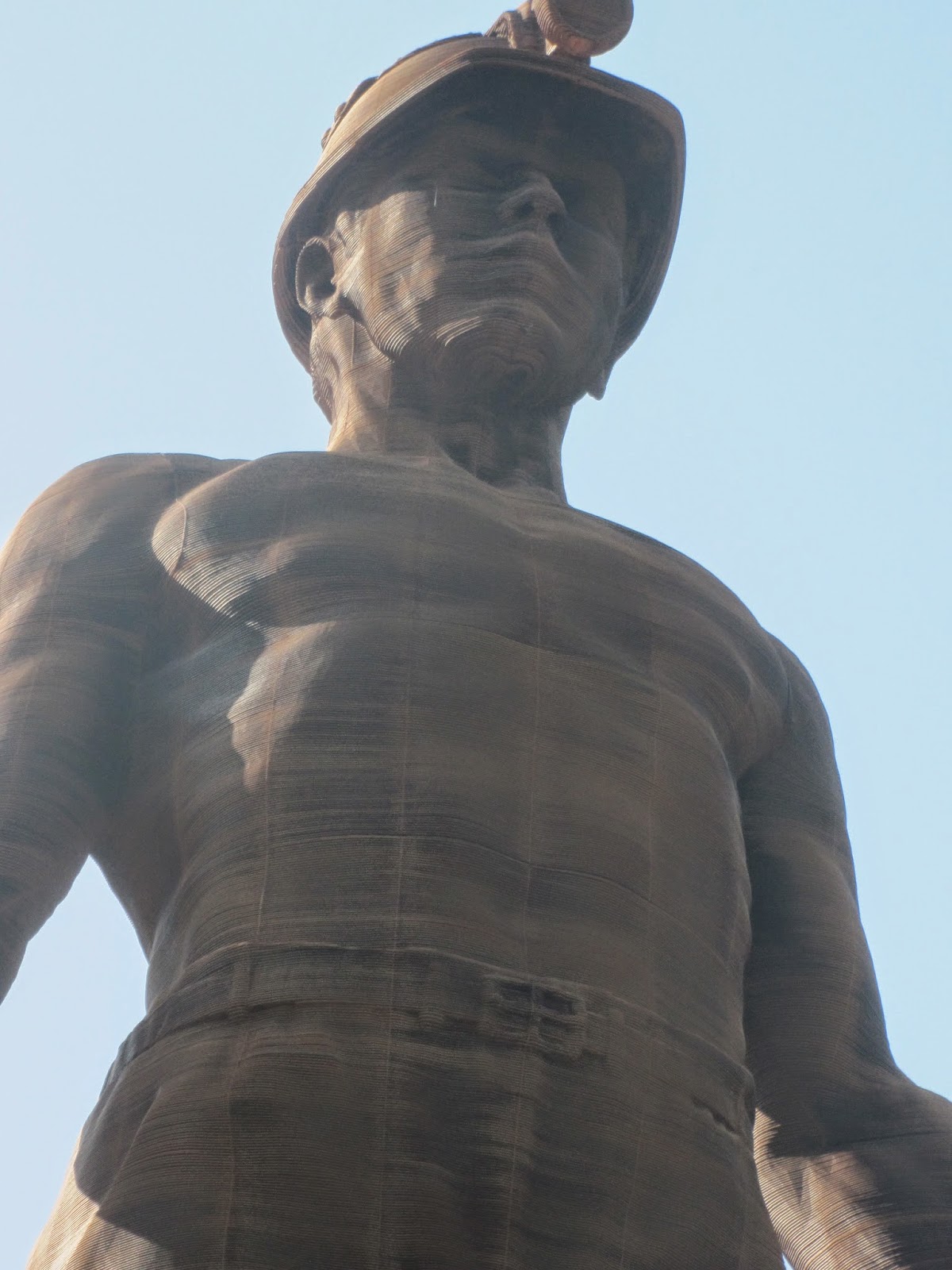
'Guardian' a twenty metre high monument has been erected on the site to commemorate a mining disaster in 1960 when 45 men lost their lives.

Sebastien Boyesen's 'Guardian' erected 2010

Monday, 26 May 2014

Queen's Baton Relay at Guardian Six Bells

After the Queen's Baton landed at Cardiff Airport, Six Bells, Abertillery was the first site to receive the honour of parading it for the public.  Heavy rain was forecast, but everyone came dressed for the weather and made the most of the day.


The Queen's Baton bearers at Ty Ebbw Fach Heritage Centre before the event.
Crowds flocked to the cafe and Heritage Centre, enjoying stalls located in the Conference Centre away from the elements. Abertillery Museum, and Big Pit Coal Museum enjoyed interest from the families interested in local history.


Saturday, 10 May 2014

Packhorse Bridge, Aberbeeg, South Wales


Its amazing the information you find when you are in the process of looking for something else. All this information on the packhorse bridge at Aberbeeg was logged on the following geocaching site. From the reviews, the bridge is probably harder to find than the cache hidden close to it.

Have been looking for information on this fascinating little bridge for quite a while...

http://www.geocaching.com/geocache

Although covered with a concrete surface and a modern handrail and fence, the Aberbeeg Bridge is a well-preserved example of a 17th century packhorse bridge and comprises single-span, stone-built arch some 10.5m long, 2.2m wide.
The earliest known record of the bridge is found in a survey of the boundaries and customs of the manor of Wentsland and Bryngwyn (of which the parish of Llanhilleth formed a part) dated 1659: 
“a river there called Eboth which said Brook and River are the mears Between the parish of Lanhilleth and parish of Mynuthusloin and so upward . . . to a place called Cymmarddwy Eboyth which is the meeting of two Rivers of that name in which place are the meeting of  Three parishes that is to say Lanhilleth, Aberustruth and Mynuthusloin and so along the river called Eboyth vychan to the middle of a bridge there called Pont y Cymmar and from thence as the Highway leadeth towards the parish Church of Lanhilleth . . .”(Bradney, p. 465)

At this time, the bridge was known as “Pont y Cymmer” (“the bridge at the confluence of two rivers”).  In this case, the confluence was that of the rivers Ebwy Fawr and Ebwy Fach that formed the boundary between the parishes of Aberystruth and Llanhilleth.  By 1775, it was known as Llanhilleth Bridge and the Minute and Account Book of the parish of Aberystruth (GRO D.739 Vol I) records repairs carried out in that year by a John Watkins at a cost of 12 shillings, one penny and ha’pence!  In 1779, Edmund Jones recorded that there were ten stone bridges in the parish of Aberystruth (Jones, p. 56).  Aberbeeg Bridge is the sole survivor.
Local tradition maintains that John Wesley, the founder of Methodism, preached at the bridge.  However, despite the fact that John Wesley did visit the parish in April 1740 during his second visit to Wales, there is no mention of the place in either his Diary or Journal.  On Tuesday, April 8th, in the company of Howell Harris, he travelled from Pontypool to Llanhilleth and preached there on the text “I know that in me dwelleth no good thing”.  He stayed overnight and, the next morning, read prayers at St. Illtyd’s church before preaching on “I will heal their backsliding, I will love them freely”.  He then travelled on to Cardiff (Williams,
pp. 6-7).
The nearby Ebbw Fach Trail from Brynmawr to Llanhilleth (the old railway line)

By 1828, the Monmouthshire Tramroad, which ran from Nantyglo Ironworks to Newport, ran past the bridge on the east bank of Ebwy Fach (GRO D.397.390).  The 1843 tithe map for the parish of Llanhilleth (GRO D.1163) shows that by this time William Webb had already established his brewery and public house near the eastern end of the bridge.