Showing posts with label Six Bells Disaster. Show all posts

Thursday, 25 June 2015

Six Bells Pit Party, South Wales


Pit Party 2016

Saturday, 21st May 2016

Weather permitting, there will be stalls, rides, local radio and much much more. 
This could be the last Pit Party as Blaenau Gwent Council are 
planning to build a school on Parc Arael Griffin, previously the site
of the Six Bells Colliery.


---ooo0ooo---


Bad weather has been forecast for Saturday.  Please ensure 
this event is taking place before travelling any distance.

22 August 2015
Sure it will be well worth the wait !!


Monday, 9 June 2014

Valerie Gantz and Six Bells, South Wales

Back in the 1980's the artist Valerie Gantz stayed for a while in a row of cottages overlooking the Six Bells Pit.  It was in full working order at that time and she gained permission to go down with the men to make sketches.

At Ty Ebbw Fach Heritage Centre, Six Bells is an evocative image of hers of miners against the glow of street lights. In June we had a print of another of Valerie's images donated by Mr & Mrs A James.

Copyright of Valerie Gantz, Six Bells Pit, 1986.

This is a wonderful scene of the Six Bells Pit in 1986. All these buildings were removed and the shafts capped in 1990's and it has now been nominated a nature conservation area.

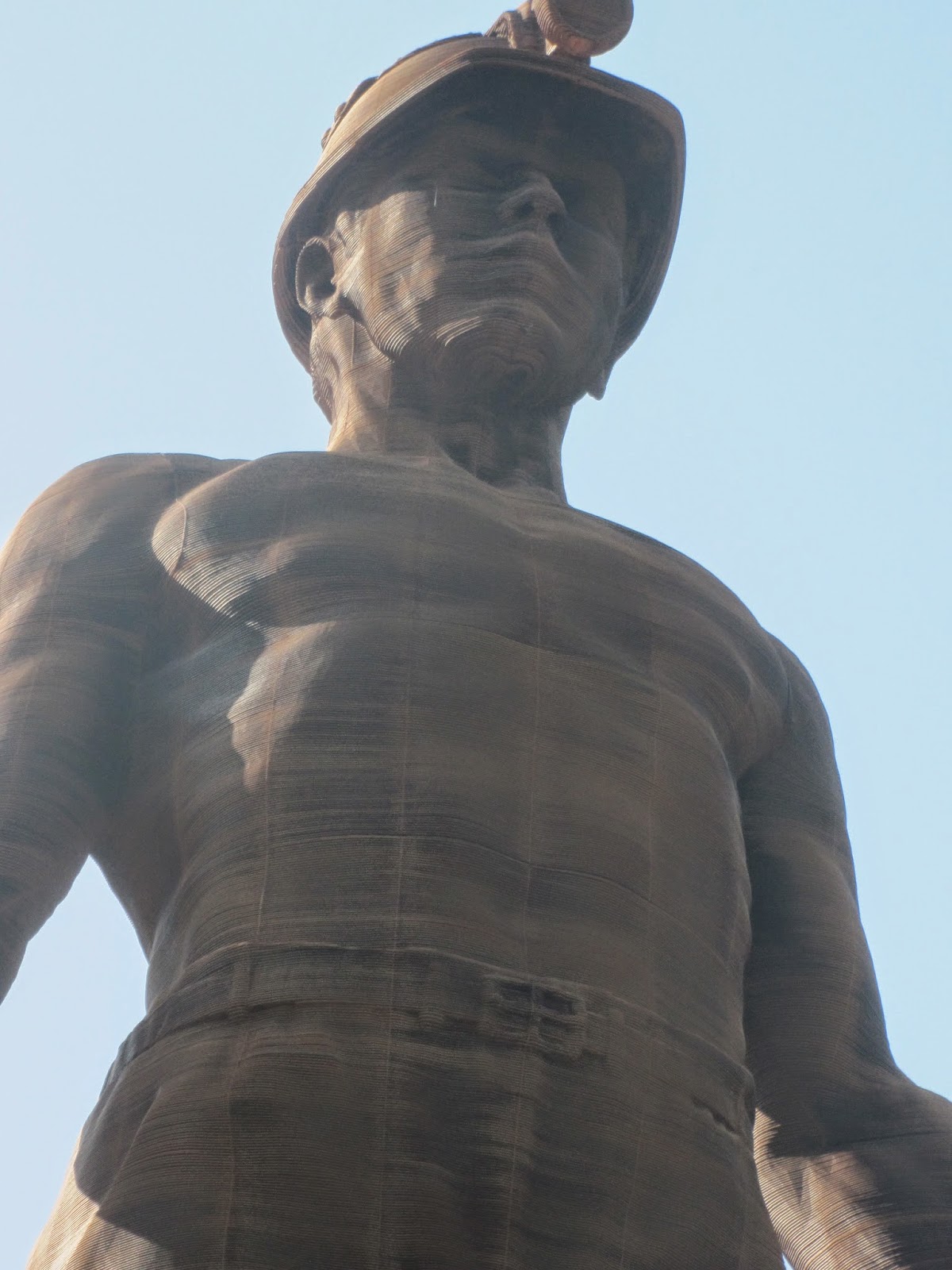
'Guardian' a twenty metre high monument has been erected on the site to commemorate a mining disaster in 1960 when 45 men lost their lives.

Sebastien Boyesen's 'Guardian' erected 2010

Thursday, 24 October 2013

Was Six Bells linked to Titanic?

After the tragedy of Titanic sinking in 1912, the only item allowed to be retrieved from the site was coal. The ship had been fuelled with steam coal. Six Bells Colliery was renowned for its quality steam coal.

Coal

I'm not recommending this, but online you can purchase a medal with a few grains of coal on one side and an image of Titanic on the other. 

The certificate of authenticity provided by these sites shows Six Bells as the source of the coal.
More coal
An excellent story, but...

Research shows coal from the valleys was taken to the ports of Newport and Cardiff by railway, and piled in heaps on the dockside. It was then removed from these heaps and loaded onto steam ships as fuel or cargo (or both). As the heaps would consist of coal from many coal mines, it would be difficult to identify the exact source of the coal.


Even more coal
Also, an online source indicates that a coal strike around the time of the launch of Titanic in 1912, meant there was actually a coal shortage.


To ensure the launch happened as planned, coal was taken from sister ships and loaded onto Titanic. This would appear to make it even harder to identify the source of the coal on Titanic when it sank.


As for me, I like the idea of it being from Six Bells, but I wouldn't put my shirt on it.

Six Bells Colliery was sunk by John Lancaster in 1891 with a team of highly skilled "sinkers" from Somerset. Unfortunately, four men fell to their death during the sinking of the two shafts. It was then known as the Arrael Griffin. The pit closed in 1988 and the site landscaped at the end of the 1990's. The colliery site has reverted back to its original name, and is now known as Parc Arrael Griffin.

On 28 June 1960 an explosion occurred underground killing 45 men. The Guardian memorial was erected by the community in 2010 to commemorate this disaster. The sculpture stands 20 metres high and its history is told in the Heritage Room, located in Ty Ebbw Fach, previously the Coach & Horses Pub which dates back to the 1800's.

www.tyebbwfach.co.uk

www.guardianwales.info

www.pinterest.co.uk/margaretgurney/guardian-six-bells/


Tuesday, 9 April 2013

Six Bells near Abertillery, South Wales

When the Six Bells Pit closed in 1964, the area lost its purpose.  With a strong community spirit and a little help, they have created a village to be proud of.  Their first project was to revitalise a rather dreary tunnel under the railway.  The history of the village, complete with farms, the pit and chapel was illustrated.

Gateway signs were also erected along with Pippin art in the tunnel under the roadway.

The Community Council erected a miners' memorial in the 1990's, but unfortunately, made of sandstone, it is absorbing groundwater and eroding badly.

Miners Memorial created 1990s (showing erosion)

The Ebbw Fach Trail passes this way on its way from Llanhilleth, via Brynmawr to Black Rock.  The Trail uses the disused railway line to link points of historical interest and beauty spots.  As well as cycling or walking the trail, the points can be accessed by car.

Guardian oversees the Six Bells valley, his arms outstretched in desperation.  Sebastien Boyesen's intention was to create the impression of a survivor or rescuer from the disaster in 1964 when 45 men were killed from 48 who were down the pit at the time.
The original miners' memorial with Guardian in the distance, between the hills

Guardian measures 20mtrs in height, as tall as the Angel of the North. 

Ty Ebbw Fach, once the Coach & Horses Inn, is open (except on Monday) for a welcome cup of tea and slice of cake.  The Heritage Room harks back to the 1960s (the time of the biggest postwar mining disaster).  The story of the village, the people and the disaster, is told through multi-media, photographs, and newspapers.


http://en.wikipedia.org/wiki/Six_Bells_Colliery

http://www.blaenau-gwent.gov.uk/15510.asp

www.facebook.com/GuardianWales

https://twitter.com/TyEbbwFach

http://www.museumwales.ac.uk/cy/art/online/?action=show_item&item=2192
Shows Lowry's painting of Six Bells Colliery, Abertillery.  Painting is on display in Cardiff Museum.

Sunday, 4 March 2012

Guardian & Six Bells Disaster, South Wales

Guardian 
Six Bells Colliery Disaster Memorial
Standing 20 metres high, designed by Sebastien Boyesen, this statue imposes itself on the valley.

The Guardian, a bare chested miner constructed from iron, stands on the former Six Bells Colliery site. As you drive along the valley road from Llanhilleth to Aberbeeg you pass almost at shoulder height.   The transparency of the work gives a ghostly impression.   Its construction from such heavy metal pieces was difficult and time consuming.

http://www.guardian.co.uk/uk/2010/jun/28/six-bells-disaster-memorial-abertillery

Unveiled before the arms could safely be attached, it still made an imposing figure.   Even more so now complete.   The names of 45 men including two fathers and their sons, are inscribed in metal around the base.


Explosion, 28 June 1960
On the morning of 28 June 1960 an explosion killed 45 miners, including two fathers and their sons.  The explosion was caused by the ignition of fire damp, a gas known to be present in the pit previously.  Men were quoted to have said they had to keep their heads down, otherwise they would be "nodding."   It was believed a spark was generated by a quartzite stone falling six feet approximately from the pit roof, exposed by blasting but not immediately supported.   This stone struck a metal rail from the coal conveyor.    The coal dust in the air then ignited along with the gas.


Six Bells Colliery (now demolished)


wild life returns where heavy industry prevailed