Showing posts with label Welcome to Wales. Show all posts

Friday, 21 March 2014

Wales, the best country in the world for walking !

Pathway at Blaensychan, Pontnewynydd
Ramblers Cymru, the welsh arm of the ramblers organisation (link below) are trying to establish Wales as the number one country in the world for walking. Their aim is for good footpaths and access to natural landscapes such as forests and rivers. We already have a phenomenal amount of walking space, whether its prepared pathways or across country and mountain for the more adventurous.  Please wear appropriate clothing as our weather can be changeable, especially if you are climbing/walking mountains.

 Mon & Brecon Canal and tow path

 Nick Smith, MP for Blaenau Gwent has said:

 "Blaenau Gwent is one of the most beautiful areas
 in Wales if not the world, and I want people to access it."

"Campaigns such as this deserve as many people as 
possible to get involved, because we can unlock the
world around us and become even more connected to 
the borough."

Moss-laden wall along the old railway line pathway 

Blaenau Gwent is only one small part of beautiful South Wales. All the counties have their own special places and scenery:  Torfaen with Pontypool's Park;  Monmouthshire with the Wye Valley;  Caerphilly with its castle to name just a very small number of places you can visit.


http://www.ramblers.org.uk/en/campaign-with-us/wales-for-walking.aspx

Leighton Andrews, Assembly Member for the Rhondda mentioned the campaign in his blog, and has shown his support by becoming a member.

http://www.leightonandrews.com/?p=2070

Does a fairy live here?  Located in Llanyrafon park

Wednesday, 5 March 2014

The Road to Wales

coming home
The winter of 2013/4 is officially the wettest on record, with rain possibly every day for months on end. In places the amount expected for a month was falling in one day. The result was extensive flooding around many rivers in Wales and England.

Farmland, now a lake
Having included many aspects of South Wales in this blog I felt I should also include this particular phenomenon. Perhaps it will be a regular occurrence every winter, or just a one-off. We shall see. As I travelled back to Wales the other day, I took an opportunity to photograph some of this flooding.

Swans making themselves at home...
Although the Welsh always complain about the rain, it is the reason our countryside looks so green and lush most of the year.

The historic bridge at Monmouth. The water subsiding.

Swans are enjoying this impromptu island, created by the debris brought down the river by the extensive flood waters. When it was safe to do so, this was cleared away, to help water flow.

Monmouth football field (water polo?)

Now, in March the pattern of storms seems to have changed and we have had a few sunny days, but the ground everywhere is still sodden and once grassy expanses have become muddy bogs. The feet of people and dogs and horses hooves just ploughing up footpaths to make them impassable.

At the moment, if you come to Wales to enjoy the countryside, then bring your wellies!


View of river Usk from the ancient bridge

Friday, 17 May 2013

A valley's town, South Wales, then & now

1930s

In the industrial South Wales Valleys, trees had been stripped from the mountains over centuries to burn in the iron furnaces or prop up miles of tunnels beneath the ground. Smoke from the iron forges and tin works, lay heavy in the air, suppressed by layers of smoke and fumes from the day before and the day before. Smells from industrial waste and sewage lingered in the nostrils of poorly clad people trying to avoid queuing for the feeding stations of the Depression.

The river flowed black with coal dust from the washeries, and sewage.
Industrial waste was dumped, if not in the river, then as close as possible to its place of origin, on any unused land.  The outline of these huge mounds mirrored the glorious mountains they were fouling,  and blocked out the view from small cottages and farms.

In winter, snow turned everything white for a mere minute or two before being covered in a layer of coal dust from the mines, and soot from the many house fires. 

Women, after working hard with a rubbing board and soap on the week's laundry, often found it soiled on the washing line. 

BUT  TOWNS HADN'T ALWAYS LOOKED LIKE THAT !


1700s

According to Edmund Jones, born 1702, the Minister of Tyllwyn Congregational from 1739 to 1779, quoted by Arthur Gray-Jones in his book Eve of the Industrial Revolution 1779

... was a pleasant, remote, well-wooded upland valley. There were good pastures on the hillsides and cornfields along the bottom of the valley, but the valley was not very fertile, especially at its northern end where the soil was thin and the land poor and barren. There was no village or hamlet, merely scattered whitewashed farms and cottages in a beautiful setting.

Every house had its clear wholesome springs of water and delightful prospects of hills and mountains, and an abundance of flat stones for tiling the roofs and flooring the kitchens and making pathways and plenty of coal for firing.

Who, he asked, would exchange a dwelling here for one in any other part of England or Wales?

Air was wholesome and inhabitants healthy and the climate a temperate one, though it was certainly colder on the hillsides and in the north of the district than in the sheltered valleys.


TODAY !

2013
 
Today the clamour of the great industries of iron, steel, coal, copper and tinplate have ceased, replaced by a new-found identity. Tips have been removed and hillsides landscaped. Trees are returning to the hillsides.
 
Historians and tourists still seek out evidence of our industrial heritage, but the natural greenery has returned with abundance, with the help of volunteers and local governments. Nature is healing many scars.  Rows of cottages as quaint as any Cornish village can be seen on the hillsides, but without Cornwall's clamour of summer traffic jams clogging the narrow streets.

Local people banter with each other and are always willing to help a stranger with directions, or to pass the time of day.

Positioned on the path of the Gulf Stream, valley towns have a mild (if rather damp), climate, creating lush vegetation.  Plant enthusiasts find wonderful wild flowers and garden species.   In spring, magnolias thrive in a garden in nearly every street. Kerbside primroses and daffodils add to the spectacular scenery of mountains all around.

Many towns have a weekly market, as well as 'out of town' shopping, often wtih free parking and places to eat.


SO!
2014/5
 
If you haven't already done so, perhaps you will find the time and opportunity to pay us a visit.  I'd love to hear from you.


Thursday, 7 June 2012

Welcome to South Wales

According to statistics stay-cations are all the rage, as opposed to vacations.  So why not travel along the M4 and come and see us?

M4 entry to Wales
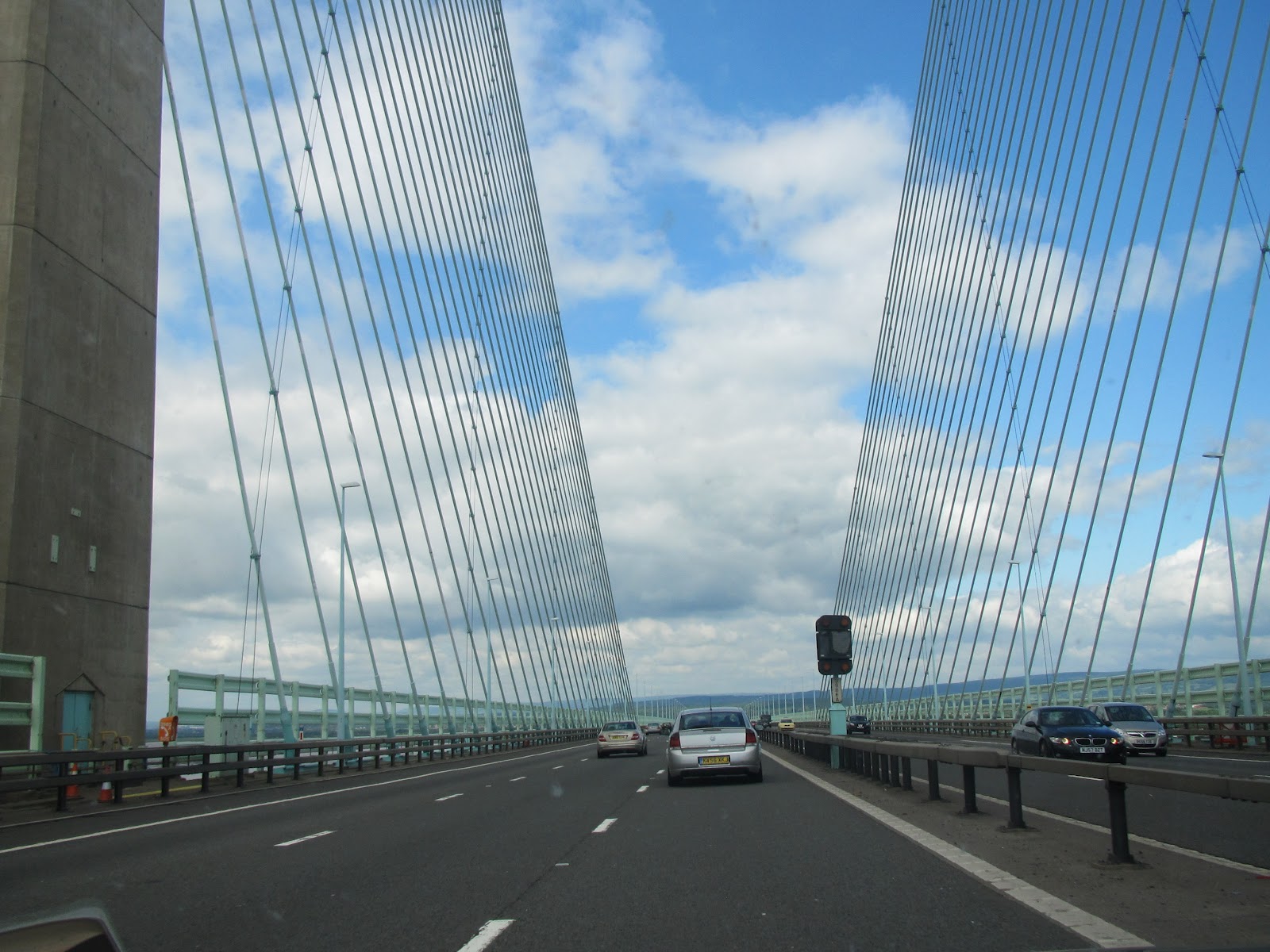
Unlike most European countries, you don't need a passport to enter Wales (from England, anyway).   But if you enter along the Severn Bridge and M4 you will be required to pay a toll (currently £6 for cars).

The alternative is to travel to Gloucester, then Ross, Monmouth and Usk - quite a detour.

Any resemblance to welsh harp strings is purely coincidence.


The second Severn crossing is a beautiful suspension bridge, although as with other suspension bridges around the world, it has its internal problems.   The tiny wires making up the cables are slowing rusting and 'twanging.'    Don't panic, its okay, honestly.   They have a machine monitoring the number of twangs, so they will know if they have to close it.

Caravan holidays can be fun !


A brief view of the mudflats as you pass when the tide is out.


Sorry if you don't like poetry, but I thought you might like this one:

A Portrait of Lady Severn 

Moon-pulled, her skirts swirl and sway,
each frill encrusted with humans
                precariously balanced.
Enamelled bands adorn her throat and wrist
                bejewelled with Fords, Hondas and Mercedes.

To a symphony of seabirds
she glides to and fro attended by bobbing barnacled craft,
                fish dancing lip service at her feet.
Salmon and lamprey travel back year on year to her voice’s call.

 The sunset glitters bronze and gold
on the swathes of her mud spattered robe,
              creating admirers from passers-by.

 Her seaweed coiffure curls round her enigmatic face
as it reflects the joys and stormy sorrows of passing clouds.
History hides beneath her stare, giving glimpses to the few
of her treasures held for future’s eye,
                beneath those terracotta skirts.
 

Her eyes sparkle with untold truths.
Artists attempt to interpret her beauty
but no-one can reveal the many facets

                       of this Mud Flour Madonna,
this Sedimentary Salomi,


Majectic  Lady of the Sea,
 

                                                         The Severn Estuary.
 by Meg Gurney