Showing posts with label coal industry. Show all posts

Friday, 13 December 2013

Senghenydd new miners' memorial


Unveiled one hundred years after the horrific pit explosion, in September 2013, the national miners' memorial sited at Senghenydd is well worth a visit, especially if you approach over the common from Nelson, enjoying the scenery and fantastic views beforehand.

The car park is small, but there are no parking restrictions on the road outside.

The two miners depicted in bronze are very well sculpted and each holds a miner's lamp.

Implanted in the top of a wall surrounding the sculpture is a series of engraved tiles, each naming one of the miners killed in the explosion in 1813.

Surrounding this wall are two circles of engraved tiles at ground level.  These each provide the names of collieries, the dates of disasters which occurred and the numbers killed.

Each tile has been sponsored by families or companies named on the tile.


I can't help feeling that although impactful, the impact would have been so much stronger if the tiles had been arranged en bloc, rather than spread in rows.

The whole arrangement is surrounded by gardens, making a place of contemplation and thought.  When planted up will add to the serenity to the whole area.


Monday, 25 November 2013

Blaensychan Valley (Cwm Nant Ddu Valley) also Blaenserchan


Drive north along the eastern valley and at Pontnewynydd, turn towards Cwmffrwdoer. Follow the narrow road up the hill past the cricket club, and at the crossroads turn left. The lane ends in a small car park and a cycle gate leads to a metalled footpath.
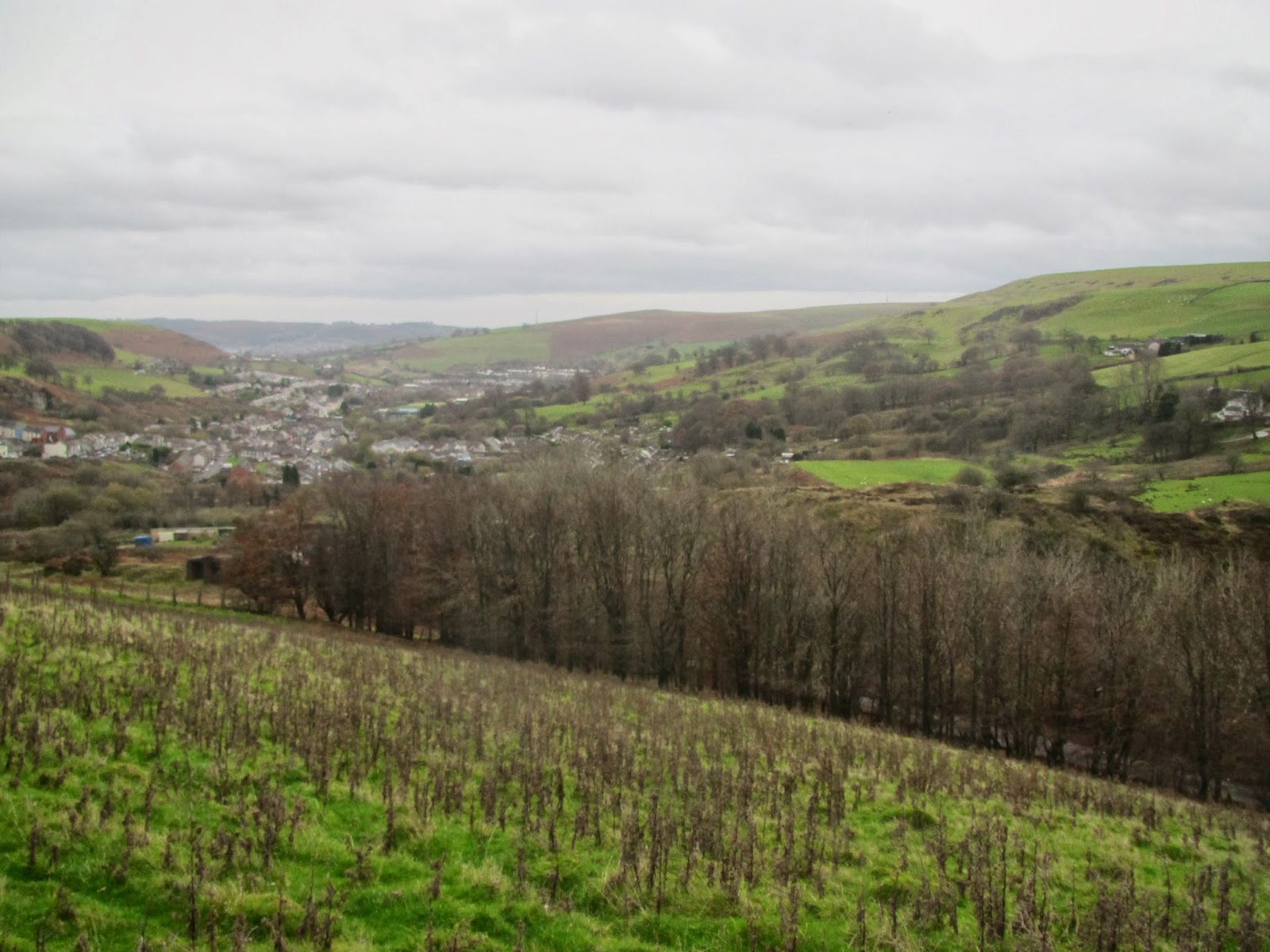
View towards Pontnewynydd and beyond

reeds and pond life returning
This footpath takes you along an almost flat walk up into the narrowing valley.  Our industrial heritage has a heavy presence for those looking for it;  slag tips, demolished buildings, sealed mine shafts and more.

But despite this dour sounding detritus, nature is ever present, gradually covering the scars left by miners earning their living.
cottoneaster


prickly gorse taking hold
Abandoned bricks from demolished buildings, proudly display their place of manufacture; "Abersychan," or "Ebbw Vale." Both brickworks now long gone.
mushrooms


The slag, dumped on the mountainside as waste, is now becoming naturalised, but motorbikes and four-by-fours erode the delicate greenery, allowing the black slag to leach and erode down the valley with every rainfall.  Even this can still look beautiful…


These holes seem to indicate yet another hazard !

Rubble of baths or canteen, white tiles still prominent


Monday, 11 November 2013

NCB Film Unit

The National Coal Board Film Unit created films documenting the working and social life of miners, from 1947 when the NCB took over many of the UKs pits. They made educational films highlighting and explaining new equipment and methods, as well as pieces which documented the social life of miners and their families. For many years, The Miners' Review was shown in cinemas all over the UK before the main feature film.

In 1947 with great enthusiasm of the employees, each pit had a notice erected:

This pit is managed by NCB for the people of Britain

How were they to know the NCB would also prove to be the demise of their coal industry.


The work of the film unit came, sadly to an end in 1984, shortly before the demise of the coal industry in Britain.  These films are a rich archive of material providing a glimpse into the lives of thousands of miners and their families. An industry which is now lost. 


Thursday, 24 October 2013

Was Six Bells linked to Titanic?

After the tragedy of Titanic sinking in 1912, the only item allowed to be retrieved from the site was coal. The ship had been fuelled with steam coal. Six Bells Colliery was renowned for its quality steam coal.

Coal

I'm not recommending this, but online you can purchase a medal with a few grains of coal on one side and an image of Titanic on the other. 

The certificate of authenticity provided by these sites shows Six Bells as the source of the coal.
More coal
An excellent story, but...

Research shows coal from the valleys was taken to the ports of Newport and Cardiff by railway, and piled in heaps on the dockside. It was then removed from these heaps and loaded onto steam ships as fuel or cargo (or both). As the heaps would consist of coal from many coal mines, it would be difficult to identify the exact source of the coal.


Even more coal
Also, an online source indicates that a coal strike around the time of the launch of Titanic in 1912, meant there was actually a coal shortage.


To ensure the launch happened as planned, coal was taken from sister ships and loaded onto Titanic. This would appear to make it even harder to identify the source of the coal on Titanic when it sank.


As for me, I like the idea of it being from Six Bells, but I wouldn't put my shirt on it.

Six Bells Colliery was sunk by John Lancaster in 1891 with a team of highly skilled "sinkers" from Somerset. Unfortunately, four men fell to their death during the sinking of the two shafts. It was then known as the Arrael Griffin. The pit closed in 1988 and the site landscaped at the end of the 1990's. The colliery site has reverted back to its original name, and is now known as Parc Arrael Griffin.

On 28 June 1960 an explosion occurred underground killing 45 men. The Guardian memorial was erected by the community in 2010 to commemorate this disaster. The sculpture stands 20 metres high and its history is told in the Heritage Room, located in Ty Ebbw Fach, previously the Coach & Horses Pub which dates back to the 1800's.

www.tyebbwfach.co.uk

www.guardianwales.info

www.pinterest.co.uk/margaretgurney/guardian-six-bells/


Sunday, 11 March 2012

Coal was the 2nd consideration


In the seventeenth century copper mining started around the Swansea area, using local coal to
smelt it for production of copper utensils.

carving of miner's tools, to scale by Harry Williams of Llanhilleth
Gradually forges cropped up all over the Valleys, smelting the plentiful iron ore,
using wood or charcoal as fuel.

With the expansion of forges, coal was used for smelting, rather than wood.   Each forge was usually accompanied by a drift mine, or coal shaft.   Local farmers had been burning coal to heat their houses, as it appeared on their land as an outcrop or very close to the surface.

As the forges expanded, steam power was developed to run machinery.   The Welsh
flannel industry was soon demanding coal for steam powered mills.   More and more wealthy house owners in London and elsewhere were demanding coal for heating.


Coal was becoming an industry in its own right, not just a fuel for the production of iron.


Thanks to Harry Williams for the photographs of his wonderful wood carvings.